
AGIF Club and Turf Management Conference
Posted on May 6, 2025
Bangkok, Thailand: Prominent industry stalwarts have confirmed their participation at this month’s Asian Golf Industry F...

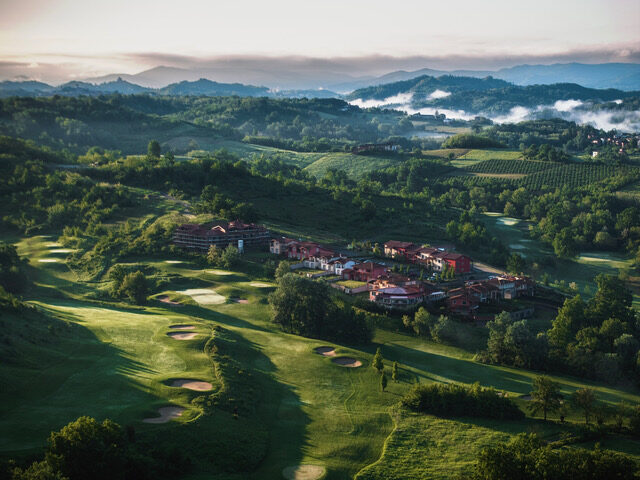
Monferrato, Piedmont, Italy: Founded in 1991, Golf Club Villa Carolina is located in a region of northwestern Italy characterised by gentle, rolling hills, plains, vineyards, orchards and forests. Approached along an avenue shaded by ancient chestnut trees, the clubhouse is the restored 18th century villa, originally a wedding gift for the noble Carolina of the Marquis Albrizzi.
Villa Carolina covers over 110 hectares between the municipalities of Capriata d’Orba and Castelletto d’Orba, with two outstanding 18-hole championship courses; firstly, La Marchesa, designed by American golf course architect Bryan Silva of Cornish & Silva. The second, more undulating Il Paradiso Course, designed by Canadian golf architect Graham Cooke, was completed in 2014.
The previous Rain Bird Nimbus ll irrigation system for the La Marchesa course was built in several stages starting in the early 1990s. After 30 years and with conditions further exacerbated by recent climate change, the irrigation system needed to be upgraded. Challenges faced were typical of systems constructed in the 1990s; PVC pipes were undersized so prone to frequent breakages, an inadequate sprinkler layout resulted in poor uniformity of water distribution and coverage, and an excessive night-time irrigation cycle exceeded 12 hours.
In 2024, the club decided to undertake a course renovation which would allow for irrigation to be managed reliably and accurately. Engineer James Massarenti designed the renovation project and is also supervising works in collaboration with superintendent Lorenzo Bisio and the club’s managers, Amedeo Daglio and Dragos Tataru.
Massarenti said: “From the outset of the design phase, I had the rare opportunity to develop strong synergy with the golf staff. This collaboration allowed me to explore all the various possibilities with them and, within the agreed budget, arrive at a shared project that truly meets the current and future needs of the course.”
The first phase began with a complete overhaul of irrigation on the back nine holes. Supported by Rain Bird distributor Scarabelli Irrigazione, the contractor Aquafert carried out work during winter.
Fausto Scarabelli explains that the project to renovate the nine-hole Marchesa course was a thrilling challenge being the first 36-hole course in Italy to adopt the Rain Bird Decoder + IC hybrid system, managed by a single PC. With 40 years plus experience in golf and sports turf irrigation, Scarabelli Irrigazione provided not only advanced products but also full technical support throughout each stage of the project – from system design and on-site assistance through to commissioning and start-up.
He said: “The adoption of the new CirrusPRO software allowed this upgrade to be completed quickly and seamlessly. We were able to support the superintendent, creating a map and database very quickly.
“Our inventory levels and Rain Bird Europe’s logistics also allowed us to deliver material very quickly, enabling the contractor to meet installation deadlines without any issues. Our specialised team is trained to Rain Bird’s highest standards and worked closely with course staff to ensure precise system configuration and optimised irrigation performance. This collaboration demonstrated how Scarabelli Irrigazione combines innovation, reliability, and field experience to deliver successful results.”
The reconstruction of the main line and secondary piping allows for triple row irrigation on the fairways, back-to-back rotors on greens and a block configuration on starting tees. Over 600 Rain Bird 752/702 IC rotors and about 200 Rain Bird block rotors were installed by Aquafert, to be operated by an upgraded hybrid system featuring the latest generation of irrigation technology, the Rain Bird IC System with CirrusPRO Central Control software. Once fully operational, the system will manage both new and existing rotors on the rest of the 36-hole course still controlled by decoders.
The second phase including the conversion of the fairways to warm season grasses and expanding the irrigation of roughs and tees of the other nine holes is nearing completion, with all renovation work expected to be finished this month.
Commenting on the conversion to warm season grasses, Massarenti said: “It’s very important to have an irrigation system that adequately covers the rough areas adjacent to the fairways, so that these zones are not penalised by the reduction in irrigation times achieved thanks to the new warm-season grasses being planted on the fairways.”
Superintendent Bisio added: “Despite meticulous efforts to minimise damage to the course, it is normal to expect that an intervention like this will affect the turf. Fortunately, the contractor and our course maintenance staff worked well together, resulting in a positive outcome. I believe that in time we will fully realise all the benefits of a modern and efficient irrigation system.
“I am truly thrilled with this work, which also perfectly complements the bunker renovation and the conversion of the fairways to warm season grasses currently underway. Once fully completed the La Marchesa course will undoubtedly reach a new level of unparalleled excellence.”
Manager Tataru emphasises that another aspect that has to be carefully considered by any other club before starting renovation work is minimising the inevitable inconvenience for golfers:
“Fortunately, our course has 36 holes, so during the winter months we were able to keep the nine holes under construction closed; the situation changes in March when player traffic increases significantly, and tourists begin arriving. In my opinion, a major effort in advance communication with members and tour operators is necessary, although I must say that in the vast majority of cases we have managed player flow without particular issues.
“Being the first summer using the new system, we have seen a drastic reduction in the time needed to complete a full night-time irrigation cycle, from 12 hours to less than eight. The course has never been so green, and player feedback has been very positive.
“While current water consumption data we have is skewed by the extra water volumes required to convert our turf to warm season grasses, on behalf of the Villa Carolina ownership, I can confirm that the new irrigation system has revolutionised our course management capabilities and, together with the significant investments made in the fairway turf and bunkers, will elevate the course to a level comparable to few others in Italy.”
*Rain Bird is an Executive Member of the Asian Golf Industry Federation.