Water Usage Reduction at US Courses
Posted on January 3, 2026
Kansas, Texas, United States: Golf courses in the US used 31 per cent less water in 2024 compared with usage in 2005, ac...

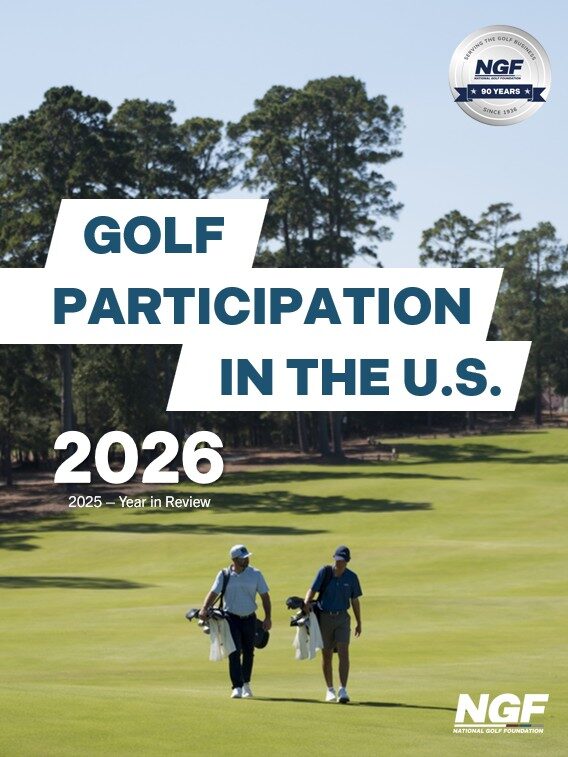
Jupiter, Florida, United States: There was a time not so long ago when the question was: ‘Why doesn’t golf grow?’ Today, the industry is experiencing a resurgence that would have been difficult to predict. Golf’s participant base in the United States has grown by 41% over the past six years (2019 to 2025) and is approaching 50 million participants.
More than 48 million Americans hit golf balls with a golf club last year, whether at traditional green-grass courses or at one of a growing number of off-course facilities that are heightening engagement with the game by making it more accessible and approachable.
Green grass golfer gains have been well-chronicled since the pandemic, with a net increase of almost five million since 2019 helping the industry approach the high-water mark (30.6 million in 2003 versus 29.1 million in 2025). The overall participation rise is even more significant across the broader on and off-course golf consumer base, jumping by almost 14 million over that same period.
During the past six years, the average annual increase in total golf participation is about 6%, with the most notable rises in 2020, 2022 and 2023. With an increase of 4% or more this year, overall US golf participation would eclipse 50 million for the first time at the end of 2026.
While the National Golf Foundation (NGF) has maintained the definitive database of golf courses and facilities for 90 years, 2026 marks the start of the fifth decade that the Foundation’s researchers have surveyed Americans regarding golf participation.
For the past 20 years, NGF has been part of the Physical Activity Council (PAC), a partnership of sports associations that co-operatively conduct sports participation research. And roughly 10 years ago, NGF’s research arm began an additional monthly – and golf-specific – Participation and Engagement Study of its own.
This came not long after the NGF expanded the scope of its research to track various forms of off-course golf engagement and better capture golf’s overall consumer base.
“Our representative research samples closely match that of the entire US population demographically, and more than 36,000 surveys inform our annual Golf Participation in the US Report, which is now available to members,” said an NGF spokesperson.
As golf’s participant funnel continues to widen – fuelled by everything from new green-grass introductory efforts and approaches to indoor simulators, golf entertainment venues and tech-enabled driving ranges – the game’s post-pandemic renaissance has not only driven record and near-record participation, but reshaped public perception around its physical, mental and social benefits.
The NGF spokesperson added: “This is perhaps the healthiest era the sport has ever experienced, which makes tracking, understanding and interpreting participation data more critical than ever to sustaining that momentum and guiding what comes next.
“These questions are at the surface of NGF’s deep on-going research into golfer behaviour and attitudes. And, as the modern US game continues its growth to 50 million participants, the latest results can be found HERE.”